
Why USDT Exchange Fees Depend on the Selected Blockchain Network

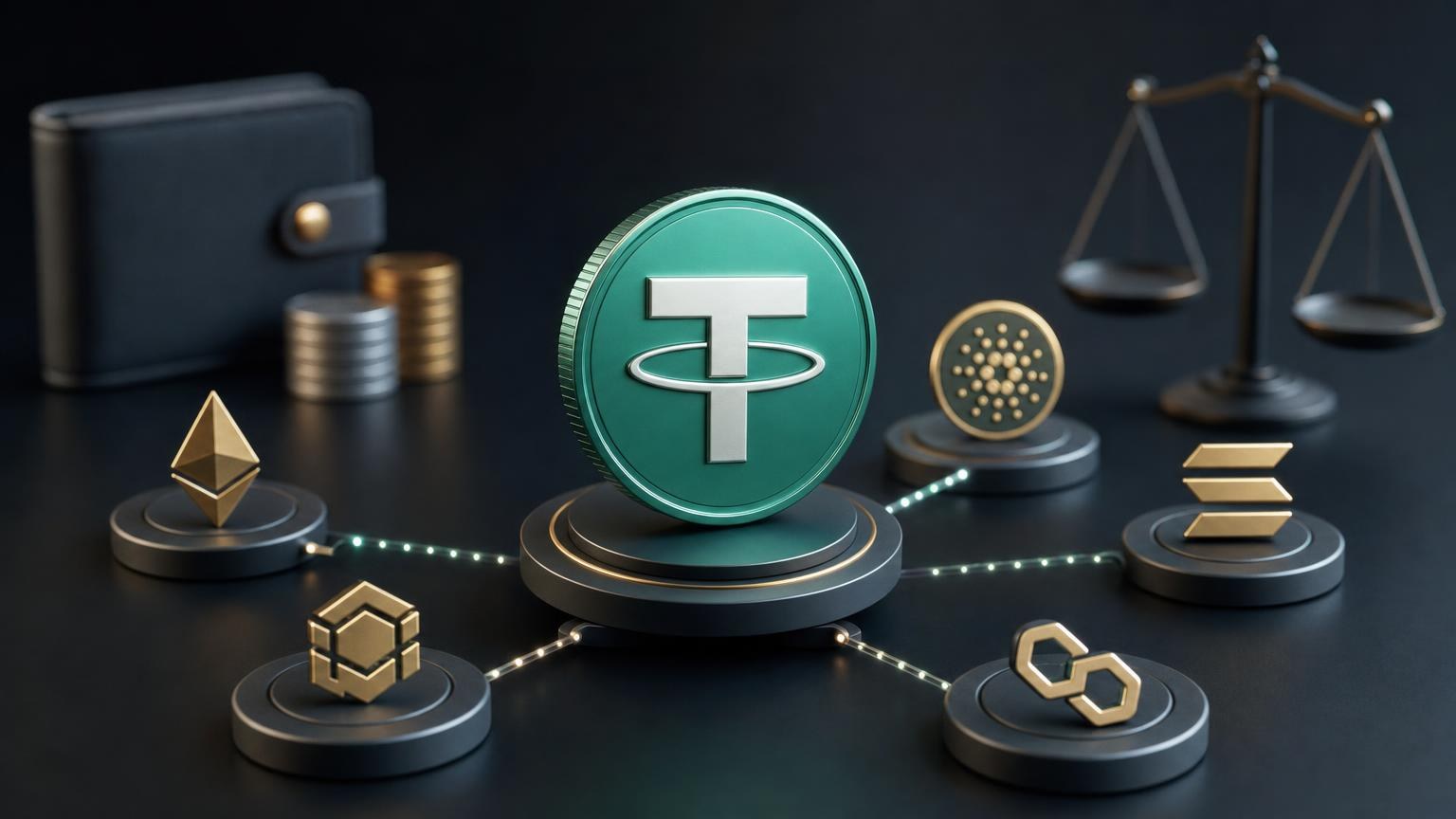
Use this term map before creating a USDT exchange order: identify the asset, match the sending and receiving networks, separate the blockchain cost from the exchange quote, and verify the final transaction by its TXID. This sequence explains why two transfers of the same USDT amount can produce different fees when they use different networks.
Essential USDT Fee Glossary
- USDT
- Exact meaning: a token designed to track the US dollar and issued on multiple supported blockchain protocols. In simple terms: USDT is the asset being transferred, while the selected blockchain supplies the transport system. Where it appears: exchange orders, wallet balances, deposit instructions, and blockchain explorers. Decision affected: you must select both USDT and a compatible network; the ticker alone is insufficient. Tether uses the native transaction system of each supported blockchain, so USDT transfers inherit the technical rules of the chosen protocol. [1]
- Blockchain network
- Exact meaning: the protocol that validates, records, and finalizes a transaction. In simple terms: it is the route along which USDT moves. Where it appears: network selectors, deposit instructions, wallet withdrawal screens, and explorer names. Decision affected: the network selected by the sender must be supported for the receiving address and exchange direction. Support can change, so current availability should be checked before every order. [2]
- Coin
- Exact meaning: the native asset of a blockchain, used according to that network’s protocol rules. In simple terms: a coin belongs to its own network, while USDT is carried as a token on that network. Where it appears: wallet balances and network-fee information. Decision affected: a self-custody wallet may require the network’s native coin or native resources to send USDT. For example, Ethereum transaction fees are paid in ETH, even when the transferred asset is an ERC-20 token rather than ETH itself. [3]
- Token
- Exact meaning: an asset represented through the rules or smart contracts of an existing blockchain. In simple terms: USDT can have the same name and intended unit of account on several networks without becoming one interchangeable on-chain record. Where it appears: token contract information, asset lists, and explorer transaction details. Decision affected: a USDT balance on one network cannot be treated as though it were already on another network; moving between networks requires a supported exchange, withdrawal route, or bridge operation.
- Address
- Exact meaning: the destination identifier to which a blockchain transaction is sent. In simple terms: it tells the network where the tokens should arrive. Where it appears: wallet receive screens, exchange deposit instructions, orders, and explorer records. Decision affected: check the full address and its stated network rather than relying on the first or last few characters. A syntactically accepted address does not by itself prove that the recipient supports the selected USDT network.
- Network fee
- Exact meaning: the protocol-level cost of processing and recording a transaction. In simple terms: it pays for blockchain resources rather than for USDT itself. Where it appears: wallet estimates, exchange withdrawal conditions, transaction receipts, and explorer data. Decision affected: networks calculate resource costs differently, and current demand can change the amount required. An exchange may reflect its expected payout transaction cost in the fee, rate, or total amount shown in the order; the exact pricing model depends on the provider.
- Gas
- Exact meaning: a measurement of computational work on Ethereum and compatible execution environments. In simple terms: gas measures the work; the gas fee is the payment for that work. Where it appears: Ethereum wallets, explorers, and transaction estimates. Decision affected: an ERC-20 USDT transfer interacts with a token contract and therefore consumes gas. On Ethereum, the final cost depends on gas used and the applicable fee per unit, including protocol and priority-fee components. [3]
- Liquidity
- Exact meaning: the amount of an asset that can be exchanged through a particular route without materially changing the executable price. In simple terms: it indicates how easily the provider can complete the selected direction and network combination. Where it appears: quoted rates, maximum available amounts, or temporary route restrictions. Decision affected: liquidity can differ by network and exchange direction, even though the displayed asset is USDT in each case. Current route availability must therefore be checked instead of assuming that every network or pair is supported.
- Slippage
- Exact meaning: the difference between an indicative price and the price actually executable when an order is processed. In simple terms: insufficient liquidity or market movement can change the conversion result. Where it appears: rate conditions and order summaries, if the provider uses a floating quote. Decision affected: distinguish slippage from the blockchain fee. Both may affect the received amount, but they have different causes.
- Confirmation
- Exact meaning: evidence that a transaction has been included in a block, followed by additional blocks or protocol-finality stages that strengthen settlement certainty. In simple terms: it shows that the network has started accepting the transfer into its history. Where it appears: blockchain explorers and deposit status pages. Decision affected: an exchange may wait for a route-specific confirmation threshold before crediting a deposit or advancing an order. Requirements vary by network, direction, and risk controls. Ethereum documentation distinguishes transaction inclusion from later justification and finalization. [4]
- TXID or transaction hash
- Exact meaning: the cryptographic identifier generated for a broadcast blockchain transaction. In simple terms: it is the lookup reference for one on-chain transfer. Where it appears: wallet history, exchange payout details, and blockchain explorers. Decision affected: use the TXID to verify the network, status, sender, recipient, token, and transferred amount. A TXID is not the same as an internal exchange order number. [4]
Connection Map: How the Network Changes the USDT Exchange Cost
USDT token → selected blockchain network → deposit or payout transaction → confirmations → explorer-verifiable result
- Object: the order specifies USDT as the asset and states an amount.
- Network or environment: the order assigns that USDT transfer to a particular blockchain. The network determines the transaction format, resource model, native fee asset, block processing, and confirmation method.
- Action: USDT is deposited to the exchange or sent from the exchange to the recipient. A provider processing a withdrawal must fund and broadcast an on-chain transaction under the chosen network’s rules.
- Confirmation: the network includes the transaction in its ledger. The exchange then applies its stated confirmation and compliance conditions before completing the relevant stage.
- Verifiable result: the TXID can be opened in an explorer for that specific network and compared with the expected address, token, amount, and status.
The selected network affects the quote because each blockchain meters transaction resources differently. Ethereum uses gas and a fee market influenced by network usage. TRON distinguishes Bandwidth for transaction data and Energy for smart-contract execution; unavailable resources may result in costs under that protocol’s model. Calling both systems simply “gas” hides a material technical difference. [3]
| Factor | What changes | What to check |
|---|---|---|
| Network fee mechanism | The blockchain calculates the resources needed to send the token under its own rules. | Current fee estimate and the native asset or resources used to pay it. |
| Network demand | Higher demand may raise the cost of obtaining timely inclusion on fee-market networks. | A current estimate shown immediately before signing or creating the order. |
| Payout transaction structure | A token transfer may require smart-contract execution rather than a simple native-coin transfer. | The selected token standard and network, not merely the USDT ticker. |
| Provider pricing method | The expected on-chain cost may be presented as a separate charge or incorporated into the quote. | The amount sent, total deductions, rate type, and expected amount received. |
| Route liquidity | Availability and executable pricing can differ across network-specific reserves or conversion routes. | Whether the exact asset, network, amount, and direction are currently available. |
| Order size | A largely fixed withdrawal cost represents a greater percentage of a small transfer than of a larger one. | Both the absolute deduction and its proportion of the amount. |
| Confirmation policy | The number or type of confirmations required can affect when processing continues, although it is not itself a blockchain fee. | The current order conditions and deposit status. |
Do Not Confuse These Terms
USDT asset and USDT network
The asset is the token being exchanged. The network is the blockchain version and transport route used for the transfer. Choosing USDT correctly but selecting an unsupported network can prevent automatic crediting and may lead to loss or a difficult recovery process. Never infer network compatibility from the ticker alone.
Coin and token
A native coin operates as part of its blockchain’s base protocol; a token uses that blockchain’s token infrastructure. The practical consequence is that holding USDT may not be sufficient to send it from a self-custody wallet. Depending on the network, the wallet may also need the native coin or allocated network resources to cover the transaction.
Network fee and exchange fee
The network fee is tied to blockchain processing. The exchange fee, spread, or quoted deduction is set under the provider’s order terms and may account for more than the raw on-chain transaction. Comparing only an explorer’s network fee with the total difference between sent and received amounts can therefore produce a misleading conclusion. Read the quote to determine which components are disclosed separately.
Gas and every blockchain charge
Gas is accurate terminology for Ethereum-style computation, but it is not a universal name for every network resource. TRON, for example, documents Bandwidth and Energy as separate resource categories. The practical consequence is that instructions written for one network should not be applied mechanically to another. [3]
Transaction and exchange order
An exchange order records the requested conversion and its conditions. A blockchain transaction records a deposit, payout, or other on-chain action. One order may involve more than one operational step, while an order created but not yet funded may have no deposit TXID. Use the order identifier when discussing order status and the TXID when verifying a blockchain transfer.
Confirmation and completion
A confirmed deposit proves progress on the blockchain; it does not automatically prove that the entire exchange order is complete. The provider may still need to match the payment, apply the stated confirmation threshold, perform compliance checks, or send the payout. Verification requirements depend on the operation direction and the results of applicable compliance procedures, so current conditions should be reviewed before creating an order.
Private key and address
An address is intended to receive assets and can be shared for that purpose. A private key or seed phrase controls the wallet and must not be disclosed to an exchanger, support agent, or person offering to “verify” a transaction. Confusing these items creates a direct theft risk. A legitimate blockchain status check uses an address or TXID, not wallet recovery secrets.
Practical Example: Comparing Two USDT Routes
Assume a user wants to exchange one supported asset for USDT. The order page presents more than one currently available USDT network, each with its own quote. No fictional fee is needed to compare them: record the input amount, expected USDT payout, selected network, address requirements, rate conditions, and any displayed deduction for each route.
Before using the available USDT exchange direction, the user should confirm that the receiving wallet supports the exact network named in the order. The service supports USDT and several other crypto assets, while new assets are added gradually, but this does not mean that every pair, blockchain, or direction is available at all times.
| Check | Route A | Route B |
|---|---|---|
| Exact network name | Copy from the current order conditions | Copy from the current order conditions |
| Wallet support | Confirmed or not confirmed | Confirmed or not confirmed |
| Expected USDT received | Use the live quote | Use the live quote |
| Fee presentation | Separate charge or included in quote | Separate charge or included in quote |
| Rate type | Check whether conditions describe a fixed or floating result | Check whether conditions describe a fixed or floating result |
| Additional identifier | Check whether the recipient explicitly requires a Memo or Tag | Check whether the recipient explicitly requires a Memo or Tag |
| Confirmation conditions | Read current requirements | Read current requirements |
The cheaper-looking network is suitable only if both sides support it. A lower displayed deduction cannot compensate for an incompatible destination. If the wallet supports only Route A, selecting Route B because its quote appears more attractive creates a network mismatch rather than a saving.
How to Recognize the Terms in a Wallet, Order, or Explorer
- In documentation: look for the exact blockchain name, token standard, native fee asset or resource model, deposit rules, and required confirmation policy. Treat supported-network lists as dynamic information and verify them at the time of the operation.
- In a wallet: identify the active account or network before copying the receiving address. Review the asset and network together. If the wallet estimates a transaction charge, note which native coin or resource is used to pay it.
- In an exchange order: compare the send amount, receive amount, network, address, quote conditions, and any separately disclosed fee. Do not assume that an asset shown as supported is available through every network.
- In an explorer: search using the TXID on the explorer corresponding to the selected network. Verify status, token, amount, sender, recipient, and block information. A result on the wrong explorer may be absent because blockchain databases are separate.
- For a Memo or Tag: use one only when the receiving service explicitly supplies it for the selected network. Do not invent, omit, or reuse an identifier from another deposit instruction.
- For security: never enter a seed phrase or private key to check a fee, trace a TXID, receive support, or recover an exchange order. Check the domain and order details carefully to reduce phishing risk.
Pre-Exchange Checklist
- Confirm that the exact USDT exchange direction is currently available.
- Write down the full network name shown by the exchange.
- Verify that the receiving platform accepts USDT on that same network.
- Check whether the destination requires a Memo, Tag, or another supplied identifier.
- Compare the expected amount received, not only the fee label.
- Determine whether the quote is fixed under stated conditions or may change with the market.
- Review current network estimates because on-chain costs can change with demand.
- Check the full address and avoid copying it from an untrusted message or advertisement.
- Review confirmation and compliance requirements before sending funds.
- After broadcast, save the order identifier and TXID separately.
- Use the correct blockchain explorer to verify the transaction.
- Remember that blockchain transactions are generally not designed for simple cancellation after valid broadcast; a wrong address or incompatible network may cause irreversible loss.
Conclusion
A USDT exchange fee depends on the selected network because USDT is a token carried by multiple blockchain systems rather than a single universal payment rail. Each network applies its own resource model, demand conditions, native fee mechanism, transaction structure, and confirmation process. The exchange may then incorporate the expected payout cost and route liquidity into its displayed fee or conversion quote.
The useful comparison is therefore not “USDT versus USDT.” It is one complete route versus another: asset + network + destination support + quoted result + confirmation conditions. Verify those elements before creating the order, then use the network-specific TXID to check what actually happened on-chain.